Category: Buying Guides

Pre-purchase education: how domes work, what to buy, what to ask.

  • Structures gonflables durables : guide complet pour les équipements sportifs

    Structures gonflables durables : guide complet pour les équipements sportifs

    Structures gonflables sportives — après avoir livré des structures dans plus de 15 pays, voici ce que tout porteur de projet doit savoir avant de signer.

    Les structures gonflables — également appelées dômes pneumatiques, bulles de sport ou structures à membrane souple — représentent une solution de plus en plus plébiscitée pour créer des espaces sportifs couverts pérennes, à moindre coût et dans des délais réduits par rapport à la construction traditionnelle.

    Ce guide présente les caractéristiques, les coûts, la durabilité et les applications concrètes des structures gonflables durables pour le sport.


    Qu’est-ce qu’une structure gonflable durable ?

    Une structure gonflable sportive est une enveloppe en membrane PVC tendue, maintenue par une légère surpression intérieure d’environ 30 à 50 pascals au-dessus de la pression atmosphérique. Des ventilateurs industriels fonctionnent en continu pour maintenir cette pression. L’entrée se fait par un sas pressurisé.

    Contrairement aux structures gonflables événementielles temporaires, les dômes sportifs durables sont : – Conçus pour une utilisation permanente (20 à 30 ans) – Certifiés pour des charges de neige de 50 à 100 kg/m² et des vents supérieurs à 120 km/h – Équipés de systèmes CVC performants, d’éclairage LED sportif et d’accès sécurisés – Conformes aux réglementations de construction nationales (Eurocode en France)


    Durabilité : combien de temps durent ces structures ?

    Type de membraneDurée de vie estimée
    Polyéthylène (PE)10 à 15 ans
    PVC enduit polyester (standard)20 à 30 ans
    PVC architecture (PVDF)25 à 35 ans

    Coûts : ce que vous payez réellement

    Coût d’investissement (projet clé en main, hors revêtement de sol)

    Type d’équipementSurfaceDôme saisonnierDôme permanent
    Bulle de tennis 2 courts~1 000 m²100 000–160 000 €155 000–270 000 €
    Dôme tennis 4 courts~2 000 m²180 000–330 000 €290 000–530 000 €
    Dôme multi-sport~3 500 m²300 000–560 000 €480 000–900 000 €
    Grand dôme football 11~9 000 m²800 000–1 500 000 €1 250 000–2 500 000 €

    Coût au mètre carré

    Spécification€/m²
    Simple peau saisonnière80 à 130 €/m²
    Double peau isolée (standard)140 à 240 €/m²
    Triple peau haute performance220 à 380 €/m²

    À titre de comparaison, la construction d’un bâtiment sportif traditionnel en France coûte généralement 700 à 1 500 €/m². Un dôme pneumatique représente donc 15 à 25 % du coût d’un équipement permanent équivalent.


    Coûts de fonctionnement annuels

    PosteDôme 2 000 m², climat tempéré
    Énergie (ventilateurs + chauffage + éclairage)22 000–50 000 €/an
    Maintenance et inspections5 000–14 000 €/an
    Assurance4 000–12 000 €/an
    Main-d’œuvre saisonnière (dôme saisonnier)10 000–25 000 €/an
    Total (dôme permanent, hors personnel)31 000–76 000 €/an

    Points de vigilance avant l’achat

    • Certification des calculs de structure (bureau d’études OPQIBI ou équivalent)
    • Classement au feu minimum M2
    • Redondance des ventilateurs (minimum 2 avec basculement automatique)
    • Permis de construire : structures > 20 m² maintenues > 3 mois sont soumises à déclaration

    HeroX AirDomes conçoit, fabrique et installe des structures à membrane souple pour le sport en Europe, au Royaume-Uni, aux États-Unis et aux Émirats arabes unis.

  • The Air Dome Buying Process: From First Call to Installation Day

    The Air Dome Buying Process: From First Call to Installation Day

    Air dome buying process – I have walked clients through these 7 stages over 50 times and the smooth projects all had one thing in common: preparation.

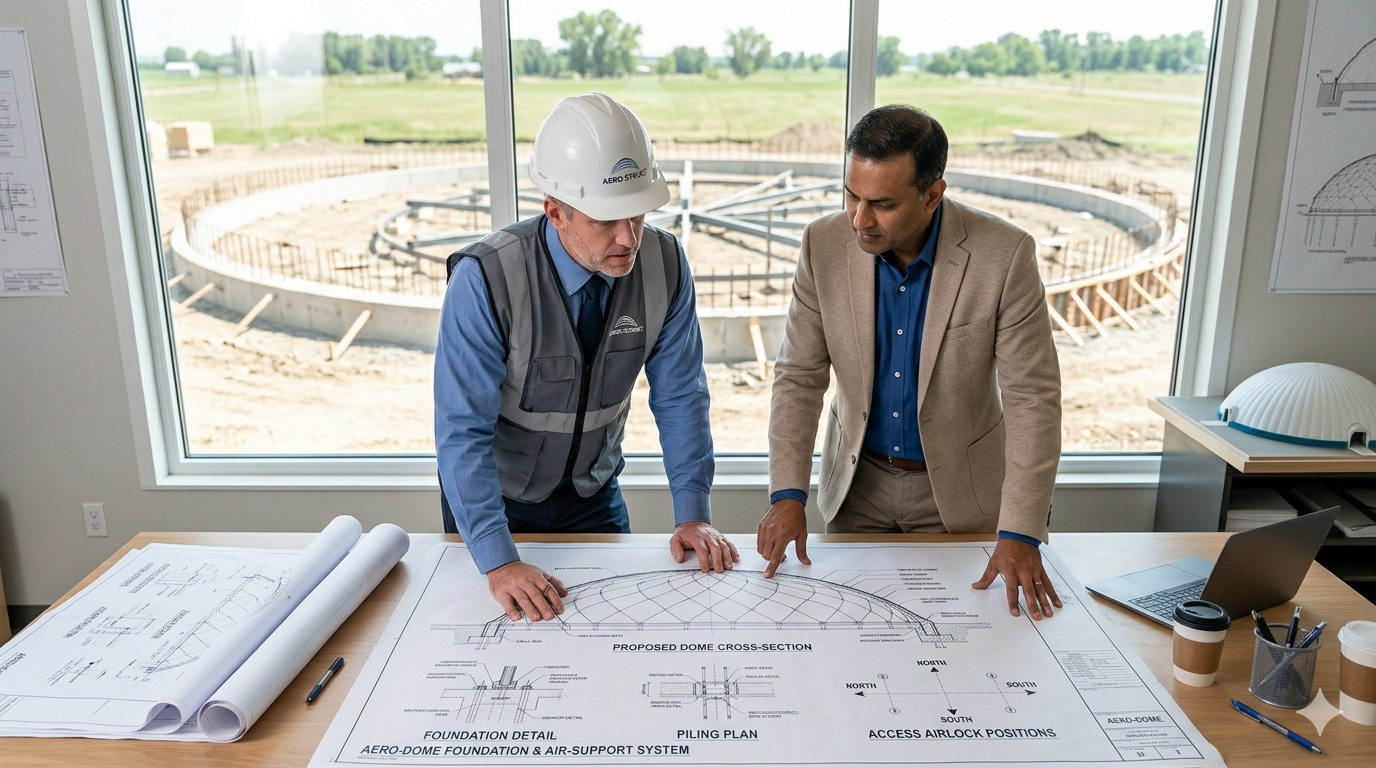
    Buying an air dome is not like ordering equipment from a catalogue. It is a bespoke construction project with engineering, permitting, manufacturing, and civil works components.


    Overview: the seven stages

    StageWhat happensTypical duration
    1. Initial enquiry and briefDefine your requirements1–2 weeks
    2. Feasibility and designSizing, specification, initial cost plan2–4 weeks
    3. Commercial and contractFormal quotation, supplier selection, contract2–6 weeks
    4. PermittingPlanning permission, structural approval4–20 weeks
    5. ManufacturingMembrane fabrication, mechanical components8–16 weeks
    6. Site preparationFoundation, utilities, access2–6 weeks
    7. Installation and commissioningInflation, testing, handover1–3 weeks
    Total from first call to first use5–10 months

    Stage 1: Initial enquiry and brief

    Your brief should include site information, operational requirements (sport, seasonal or permanent, user numbers), commercial context (budget, land tenure, target opening date), and planning context.

    Red flag: any supplier who sends a price within 48 hours without asking about your site, soil conditions, local wind/snow loads, or planning context.


    Stage 2: Feasibility and design

    At this stage the supplier develops structural design brief, mechanical design brief, and lighting design. This produces drawings, specification schedule, and an outline cost plan broken down by element.


    Stage 3: Commercial and contract

    Obtain a minimum of 2–3 quotes. Ensure quotes are comparable on membrane material, foundation type, HVAC specification, lighting, warranty terms, and engineering certification.

    Key contract terms: – Payment schedule: 30–40% deposit, 30–40% on manufacturing completion, balance on installation completion. – Delivery timeline with milestone dates. – Warranty: membrane (minimum 10 years), structure (minimum 5 years), mechanical (minimum 2 years).


    Stage 4: Permitting

    UK: seasonal domes on existing sports facilities may be permitted development. Permanent domes require full planning permission (typically 13–26 weeks).

    US: requirements vary by state and municipality. Many jurisdictions have a streamlined permit for temporary structures. Permanent structures require building permit, zoning approval, ADA compliance.


    Stage 5: Manufacturing (8–16 weeks)

    Process includes detailed structural calculations, CNC membrane fabrication, component manufacture, factory inspection, and shipping (1–2 weeks from Europe; 4–8 weeks from Asia by sea).


    Stage 6: Site preparation (2–6 weeks)

    • Ring beam (permanent dome): typically 2–4 weeks.
    • Ground anchor installation (seasonal dome): typically 3–5 days.
    • Three-phase power supply: allow 4–12 weeks to coordinate with network operator in UK.

    Stage 7: Installation and commissioning

    Typical sequence: delivery and check → airlock assembly and membrane layout → attachment to anchors → blower connection → inflation (4–24 hours) → internal rigging → commissioning checks.

    Handover documentation must include: structural engineer’s completion certificate, blower performance records, lighting commissioning report, HVAC records, emergency procedures, maintenance schedule, spare parts inventory.


    HeroX AirDomes manages the complete process — from initial feasibility through engineering, permitting, manufacturing, and installation.

  • Tennis Bubble Guide: Costs, Sizing, and What to Expect (2026)

    Tennis Bubble Guide: Costs, Sizing, and What to Expect (2026)

    Tennis bubble cost sizing – more than half our installs are tennis bubbles, so here is everything I have learned across club, municipal and academy projects.

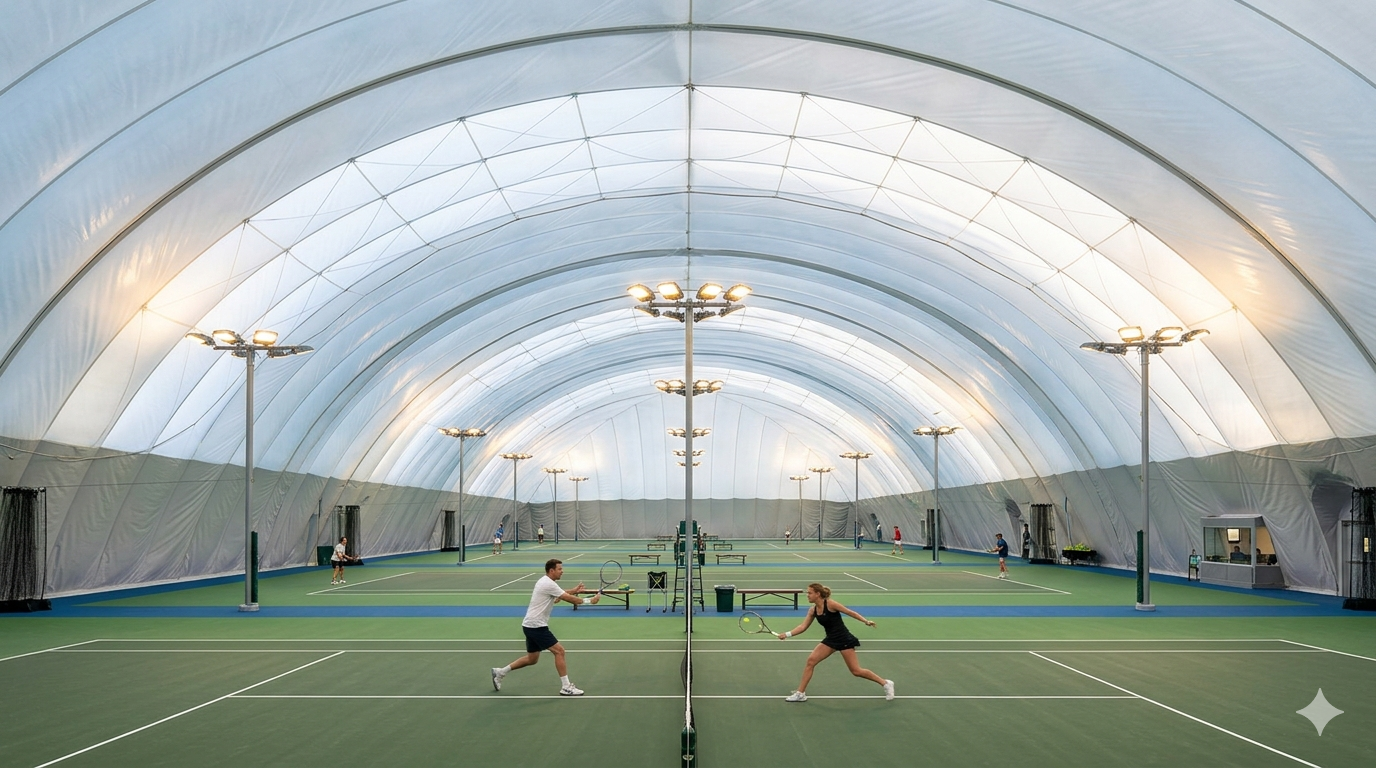
    A tennis bubble — also called a tennis dome, air dome for tennis, or tennis air structure — is an inflatable fabric enclosure that converts outdoor tennis courts into an all-weather, year-round indoor facility.


    What is a tennis bubble?

    A tennis bubble is an air-supported structure designed specifically to cover one or more full-size tennis courts. Modern tennis bubbles are: – Made from PVC-coated polyester membrane (typically 900–1,050 g/m²) – Available in single-skin, double-skin insulated, and triple-skin configurations – Equipped with LED sports lighting, HVAC systems, and pressurised airlocks – Designed for seasonal or permanent operation


    Sizing: how large does a tennis bubble need to be?

    CourtsMin. internal widthMin. internal lengthMin. ridge height
    1 court15 m (49 ft)32 m (105 ft)8 m (26 ft)
    2 courts27 m (89 ft)32 m (105 ft)8 m (26 ft)
    3 courts39 m (128 ft)32 m (105 ft)9 m (30 ft)
    4 courts51 m (167 ft)32 m (105 ft)10 m (33 ft)
    6 courts73 m (240 ft)38 m (125 ft)11 m (36 ft)

    Tennis bubble cost: what you’ll actually pay

    United States (USD)

    ConfigurationApprox. footprintSeasonal bubblePermanent dome
    1-court bubble~5,000 sq ft$70,000–$120,000$110,000–$200,000
    2-court bubble~10,000 sq ft$130,000–$230,000$210,000–$370,000
    3-court bubble~14,000 sq ft$180,000–$320,000$290,000–$520,000
    4-court dome~21,000 sq ft$260,000–$460,000$420,000–$720,000
    6-court dome~30,000 sq ft$380,000–$680,000$610,000–$1,050,000

    United Kingdom (GBP)

    ConfigurationApprox. footprintSeasonal bubblePermanent dome
    2-court bubble~900 m²£95,000–£165,000£155,000–£280,000
    4-court dome~1,950 m²£195,000–£350,000£315,000–£550,000
    6-court dome~2,800 m²£280,000–£500,000£460,000–£800,000

    Revenue potential: 4-court seasonal bubble (US suburban market)

    MetricValue
    Operating months6 months (October–March)
    Gross annual revenue$165,000–$230,000
    Annual operating costs$45,000–$80,000
    Net annual contribution$85,000–$185,000

    Payback on a $380,000 dome: approximately 2–4 years.


    Operating a tennis bubble: what to expect

    • Airlocks: slight pressure sensation on entry — most players adapt within one or two visits.
    • Sound: continuous blower hum, typically 55–65 dB at court level.
    • Lighting: LED perimeter masts; spec 350–500 lux at court level.
    • Temperature: well-specified bubbles maintain 16–20°C indoors in winter.
    • Ball flight: minor differences vs outdoors; players adapt quickly.

    Specification checklist

    • [ ] Internal clear height ≥ 8 m (1–2 courts), ≥ 9 m (3–4 courts), ≥ 11 m (6+ courts)
    • [ ] Wind load certification (typically 120–140 km/h for UK)
    • [ ] Snow load rating (minimum 50 kg/m² for UK)
    • [ ] Fire classification — minimum M2 (FR) in EU, NFPA 701 in US
    • [ ] Minimum 2 blower units with automatic failover
    • [ ] Lighting: ≥300 lux at court level (recreational), ≥500 lux (coaching/competition)
    • [ ] Membrane warranty: minimum 10 years

    HeroX AirDomes installs tennis bubbles and multi-court domes across the US, UK, Europe, and the UAE.

  • Seasonal vs Permanent Air Dome: What works for Your Facility?

    Seasonal vs Permanent Air Dome: What works for Your Facility?

    Seasonal vs permanent air dome – I have had this exact conversation with hundreds of facility owners and the right answer is rarely obvious.

    Choosing between a seasonal and a permanent air dome is one of the most consequential decisions in any sports facility project. Get it right and you match your capital and operating cost profile to your actual usage pattern. Get it wrong and you either overpay in capital, or lose revenue you could have captured.


    The core difference

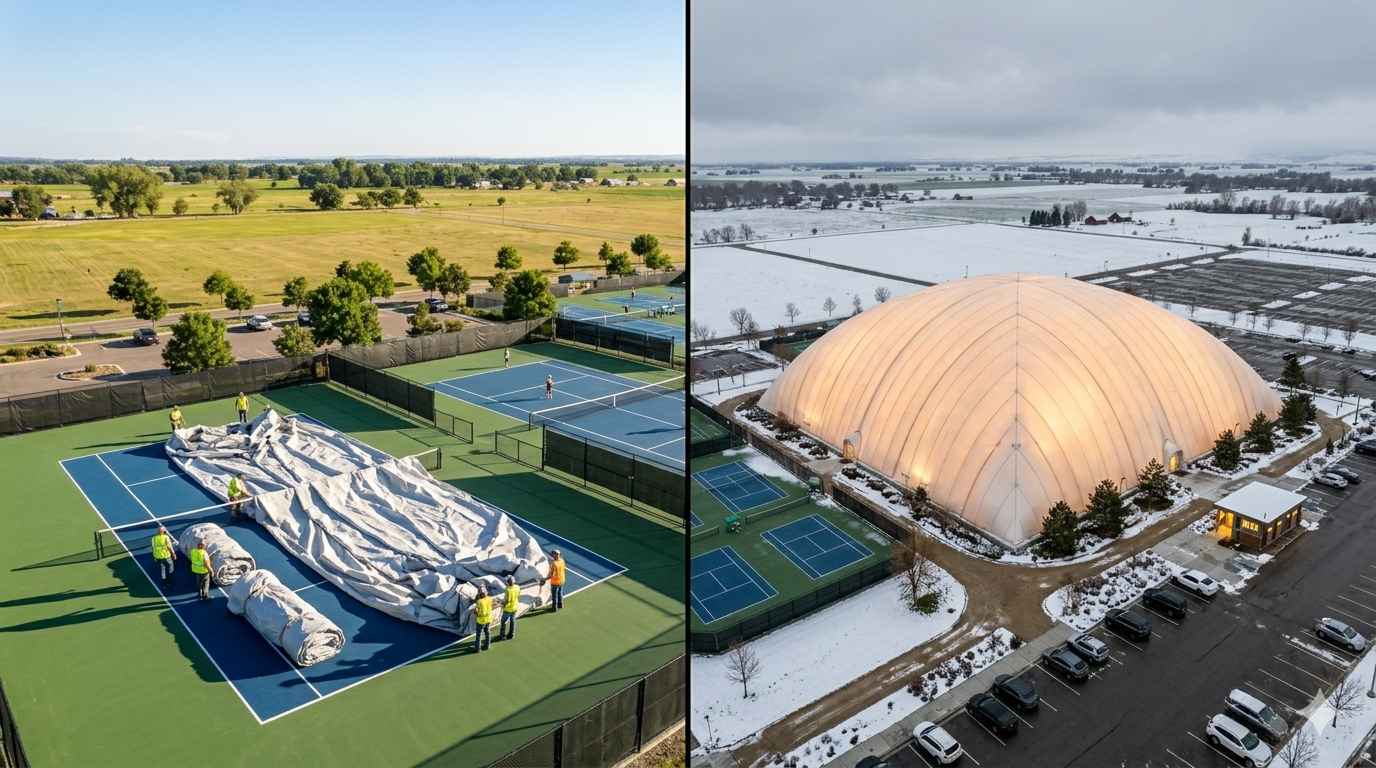
    Seasonal dome: erected in autumn, deflated and removed in spring. The membrane and mechanical equipment are stored during the off-season.

    Permanent dome: installed once and remains in place year-round. Provides 12-month indoor capacity.


    Head-to-head comparison

    FactorSeasonal domePermanent dome
    Capital cost60–75% of equivalent permanent100% baseline
    Annual installation/removal£10,000–£30,000 / $12,000–$38,000None
    FoundationGround anchors or ballastConcrete ring beam (typically)
    Summer incomeOutdoor courts generate revenueFull indoor revenue 12 months
    PlanningOften permitted as temporary structureUsually requires full planning permission
    Membrane lifespan15–25 years12–20 years (same material, more UV)
    Revenue potential5–7 months indoor / 5–7 months outdoor12 months indoor
    Break-even periodTypically 2–4 yearsTypically 4–7 years

    When a seasonal dome is the right choice

    1. You already have high-value outdoor courts or pitches in summer.
    2. Your market is in a temperate climate with defined playing seasons.
    3. Your capital budget is constrained.
    4. Planning permission for a permanent structure is difficult.

    Typical seasonal dome payback period:

    Dome sizeCapital costAnnual dome income (net)Payback
    2-court tennis bubble$150,000–$240,000$55,000–$90,0002–3 years
    4-court tennis / pickleball$320,000–$550,000$100,000–$200,0002–4 years
    Small soccer dome$480,000–$750,000$120,000–$250,0003–5 years

    When a permanent dome is the right choice

    1. Your climate is cold or wet for most of the year.
    2. You want to build a full indoor sports business.
    3. You are covering new courts rather than existing ones.
    4. You have a long lease or own the land outright.
    5. Energy cost management is a priority.

    Typical permanent dome payback period:

    Dome sizeCapital costAnnual dome income (net)Payback
    4-court tennis dome$500,000–$800,000$110,000–$220,0003–6 years
    Multi-sport (5-a-side + courts)$800,000–$1,500,000$180,000–$380,0004–6 years
    Large indoor sports centre$2,000,000–$4,000,000$350,000–$800,0005–8 years

    The total cost of ownership comparison (4-court dome, 20 years)

    Cost elementSeasonal domePermanent dome
    Year 0 capital cost$420,000$600,000
    Annual install/removal (20 years)$280,000 total$0
    Energy costs (20 years)$450,000 total$650,000 total
    Membrane replacement (year 15)$90,000$120,000
    Maintenance (20 years)$160,000 total$180,000 total
    Total 20-year cost$1,400,000$1,550,000
    Approximate revenue (20 yrs)$2,400,000$4,600,000
    Net 20-year position+$1,000,000+$3,050,000

    Decision framework

    QuestionLean seasonal if…Lean permanent if…
    What is your summer outdoor revenue?HighLow or zero
    How many months per year is outdoor sport impractical?4–6 months7+ months
    What is your lease length on the site?Under 15 years15+ years or freehold
    Do you need 12-month revenue certainty?NoYes
    Is planning permission for permanent structure viable?NoYes

    HeroX AirDomes has installed both seasonal and permanent air-supported structures across the US, UK, Europe, and UAE.

  • Air Dome Cost Guide 2026: What You’ll Actually Pay

    Air Dome Cost Guide 2026: What You’ll Actually Pay

    Air dome cost 2026 – after quoting over $12M in projects, I can show you exactly what drives the price swings.

    Understanding what an air dome costs — and why — is one of the first things any serious buyer needs to nail down. The pricing ranges you find online vary wildly because air domes vary wildly in size, specification, climate requirements, and site conditions.

    This guide breaks down every cost component, gives you real price ranges by facility type, and explains what drives the biggest variances.


    The short answer: cost ranges by facility type

    These are complete turnkey project costs including membrane, foundations, airlocks, blowers, HVAC, LED lighting, and installation. They do not include the sports flooring, which is typically specified and quoted separately.

    United States (USD)

    FacilitySizeSeasonal domePermanent dome
    2-court tennis bubble~12,000 sq ft$120,000–$200,000$180,000–$320,000
    4-court tennis dome~22,000 sq ft$220,000–$400,000$350,000–$650,000
    4-court pickleball dome~18,000 sq ft$180,000–$320,000$280,000–$500,000
    Small multi-sport (soccer 5-a-side)~35,000 sq ft$350,000–$600,000$550,000–$950,000
    11-a-side soccer dome~100,000 sq ft$900,000–$1,800,000$1,500,000–$3,000,000
    Large multi-sport complex~150,000 sq ft—$2,500,000–$5,000,000

    United Kingdom (GBP)

    FacilitySizeSeasonal domePermanent dome
    2-court tennis bubble~1,100 m²£95,000–£160,000£140,000–£260,000
    4-court tennis dome~2,000 m²£170,000–£320,000£280,000–£520,000
    Small multi-sport~3,200 m²£270,000–£480,000£440,000–£760,000
    Full 5-a-side soccer~3,800 m²£320,000–£560,000£520,000–£900,000
    11-a-side soccer dome~9,500 m²£750,000–£1,500,000£1,200,000–£2,500,000

    Europe (EUR)

    European pricing broadly tracks UK GBP on a 1:1 basis. Significant variation exists between western Europe (Germany, Netherlands, France — typically +10–20%) and eastern Europe (Poland, Romania, Czech Republic — typically −15–25%).


    Cost per square foot / square metre

    Dome specificationUSD per sq ftGBP per m²EUR per m²
    Basic single-skin seasonal$12–$18£80–£120€90–€140
    Standard double-skin insulated$25–$40£140–£240€160–€275
    High-performance triple-skin$40–$65£230–£380€265–€435

    A common rule of thumb: a well-specified permanent air dome costs roughly 25–35% of an equivalent permanent steel-and-concrete sports hall.


    What drives the cost?

    1. Membrane specification

    PE (polyethylene) membrane — lightest, lowest cost, lifespan 10–15 years. Suitable for seasonal structures in mild climates. Poor thermal performance.

    PVC-coated polyester — the industry standard. Weight typically 850–1,050 g/m². Lifespan 20–30 years. Good UV resistance, good structural performance, available in translucent grades.

    PVDF-coated / architectural PVC — premium specification with exceptional UV stability and self-cleaning properties. Lifespan 25–35 years.

    2. Skin count and insulation

    • Single-skin: U-value ~5.0 W/m²K. Suitable only for seasonal use or climates without cold winters.
    • Double-skin with air gap: ~U-value 1.5–2.5 W/m²K. Standard for year-round UK/northern Europe/northern US.
    • Double-skin with insulation layer: ~U-value 0.6–1.2 W/m²K. Recommended for facilities where heating cost is a major concern.
    • Triple-skin: ~U-value 0.3–0.6 W/m²K. Primarily specified for Scandinavia, Canada, and other severe-winter markets.

    3. Foundation and anchoring

    Anchoring methodRelative costBest for
    Continuous concrete ring beamHighest (adds 15–25% to total project cost)Permanent domes, high wind zones, large spans
    Helical ground anchorsMedium (adds 8–15%)Semi-permanent, good ground conditions
    Ballast / water-filled tubesLowest (adds 3–8%)Temporary/seasonal, low wind exposure

    4. HVAC and air management

    HVAC is typically 10–20% of total project cost. Options include warm-air units, underfloor heating, and heat pump systems.

    5. Airlock design

    • Revolving door airlock: ~£8,000–£20,000 / $10,000–$25,000 per unit.
    • Double-door vestibule: ~£4,000–£10,000 / $5,000–$12,000 per unit.

    6. Lighting

    LED lighting system cost: typically £15,000–£50,000 / $20,000–$65,000 depending on dome size and lux specification.


    Hidden costs buyers often underestimate

    • Planning / permits: allow 3–8% of project cost.
    • Site preparation: can add 10–20% for difficult sites.
    • Sports flooring: separate budget item. Artificial turf: £15–£80/m².
    • Project management and professional fees: allow 5–10% of total project.

    Annual operating costs

    Cost itemPer m² per yearPer sq ft per year
    Energy (blowers + heating + lighting)£15–£45 / €17–€52$3–$9
    Maintenance and inspections£2–£6 / €2–€7$0.40–$1.20
    Insurance£1.50–£5 / €1.75–€6$0.30–$1.00
    Seasonal labour (seasonal domes only)£4–£12 / €5–€14$0.80–$2.50
    Total operating (permanent dome)£18–£55 / €20–€63$3.50–$10.00

    What you should not cut to save money

    • Don’t skimp on membrane quality.
    • Don’t omit backup blower capacity.
    • Don’t undersize the foundation.

    HeroX AirDomes provides detailed itemised quotations for air-supported structures across the US, UK, Europe, and the UAE. Request a free feasibility assessment and indicative cost plan.

  • The Definitive Inflatable Dome Buying Guide (2026)

    The Definitive Inflatable Dome Buying Guide (2026)

    After designing and delivering air-supported structures across 20 countries, I can tell you that most buyers walk in asking the wrong questions – this guide (Inflatable dome buying guide) is built on everything I wish they had read first.

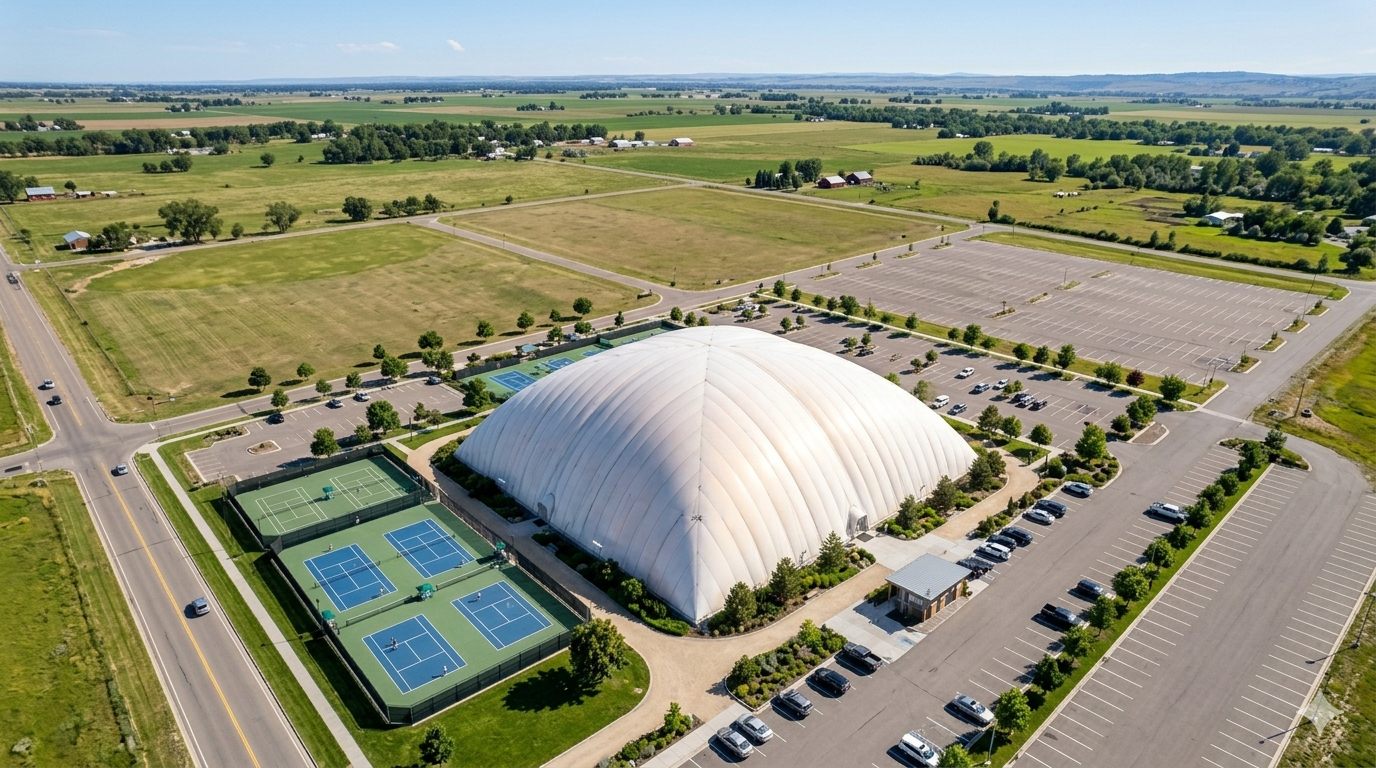
    Inflatable domes — also called air-supported structures, sports bubbles, or air domes — are large-span fabric enclosures held up entirely by slightly pressurised air. They are the fastest and most cost-effective way to create climate-controlled, column-free indoor space for sports, storage, events, or industry.

    This guide covers everything you need to know before buying: how they work, what they cost, what sports they suit, how long they last, and what the buying process actually looks like.


    What is an inflatable dome?

    An inflatable dome is a fabric membrane — typically PVC-coated polyester or polyethylene — anchored to a concrete ring beam or ground anchors. Industrial blowers maintain an internal air pressure of around 30–50 Pa (pascals) above ambient. That small pressure differential is enough to keep a membrane spanning 30–100+ metres with no interior columns.

    Entry is via an airlock vestibule or revolving door that maintains pressure while allowing people to pass through freely.

    They are not the bouncy-castle inflatables you see at fairs. Commercial air-supported domes are engineered to withstand snow loads of 50–100 kg/m², wind speeds above 100 km/h, and decades of continuous operation.


    Types of inflatable dome

    TypeDescriptionBest for
    Single-skinOne-layer membraneSeasonal use, warm climates, storage
    Double-skinTwo membranes with insulating air gapYear-round sports, cold climates
    Triple-skinThree layers with insulation pocketsArctic climates, premium facilities
    Seasonal domeInstalled in autumn, removed in springTennis clubs, soccer clubs covering existing courts
    Permanent domeYear-round, fully anchoredIndoor sports centres, 12-month revenue facilities

    What sports do inflatable domes cover?

    Inflatable domes are used across virtually every outdoor sport. The most common applications are:

    Tennis — The tennis bubble is the most established dome format globally. A standard seasonal bubble covering 2–4 courts is typically 25–30 m wide and 50–70 m long, allowing full ITF-compliant court dimensions plus run-off.

    Football / Soccer — Full-size 5-a-side, 7-a-side, and 11-a-side pitches. A regulation 11-a-side synthetic turf pitch requires a dome of approximately 80 × 120 m.

    Padel — One of the fastest-growing applications. A 4-court padel dome is typically 30 × 60 m.

    Pickleball — Surging in the US. Multiple pickleball courts can be covered in a relatively compact dome footprint.

    Golf — Driving range bays, short-game areas, and putting greens.

    Multi-sport — A single large dome can house several different court configurations simultaneously: basketball, volleyball, badminton, and futsal are commonly combined under one shell.

    Athletics — Throws cages, sprint tracks, and combined multi-event training facilities.

    Hockey — Field hockey and ice hockey (the latter requires a refrigeration system in the floor).


    How much does an inflatable dome cost?

    Costs vary based on size, skin type, insulation level, HVAC specification, and whether the dome is seasonal or permanent. The following ranges are indicative for a complete turnkey project including foundations, airlock, HVAC, and lighting.

    Facility typeApprox. sizeTypical cost range
    2-court tennis bubble (seasonal)1,000–1,500 m²£120,000–£220,000 / $150,000–$280,000
    4-court tennis / pickleball dome2,000–3,000 m²£280,000–£550,000 / $350,000–$700,000
    Small multi-sport dome2,500–4,000 m²£350,000–£700,000 / $450,000–$900,000
    Full soccer pitch dome9,000–12,000 m²£800,000–£2,000,000 / $1,000,000–$2,500,000
    Large multi-sport complex12,000–20,000 m²£1,500,000–£4,000,000 / $2,000,000–$5,000,000

    Cost per square metre / square foot:

    Dome specificationPer m²Per sq ft
    Basic single-skin seasonal£80–£120 / $15–$22—
    Double-skin, insulated (standard)£140–£200 / $25–$38£13–£19 / $25–$38
    Triple-skin, high-performance£200–£350 / $38–$65£19–£33 / $38–$65

    These figures typically represent a 50–75% saving on equivalent permanent steel-and-concrete construction.


    Annual operating costs

    Running an inflatable dome is not free. The main ongoing expenses are:

    Energy — Blowers run 24 hours a day, 365 days a year (or seasonally). A 2,000 m² dome typically draws 7–12 kW for pressurisation. Heating in cold climates adds significantly: a well-insulated double-skin dome requires approximately 30–60 W/m² of heating capacity. Annual energy costs for a 2,000 m² dome range from £15,000–£45,000 / $20,000–$60,000 depending on climate and insulation specification.

    Maintenance — Annual inspection, blower servicing, anchor checks, minor fabric repairs: typically £3,000–£10,000 / $4,000–$12,000 per year.

    Insurance — Commercial inflatable structure insurance: typically £3,000–£12,000 / $4,000–$15,000 per year.

    Seasonal labour — For seasonal domes: installation and removal crew, typically £8,000–£25,000 / $10,000–$30,000 per year.

    Total operating cost benchmarks:

    Dome sizeAnnual operating cost range
    1,000–2,000 m²£25,000–£70,000 / $30,000–$90,000
    2,000–5,000 m²£50,000–£130,000 / $65,000–$160,000
    5,000–12,000 m²£100,000–£350,000 / $130,000–$450,000

    How long does an inflatable dome last?

    Membrane lifespan depends primarily on material quality and UV exposure:

    • Polyethylene (PE) membrane — 10–15 years. Lower cost, lighter weight, less durable.
    • PVC-coated polyester membrane — 20–30 years. Industry standard for commercial sports facilities.
    • PTFE / architectural fabric — 30–40 years. Premium specification, higher cost.

    Structural components (anchoring systems, airlocks, blowers) typically have serviceable lives of 15–25 years with regular maintenance.

    The blower system — typically 2–4 industrial fans with automated backup — should be serviced annually and replaced every 12–18 years.


    Installation timeline

    From contract signing to first use:

    PhaseTypical duration
    Engineering and drawings4–8 weeks
    Permitting (varies by jurisdiction)4–16 weeks
    Membrane manufacturing8–14 weeks
    Foundation and site preparation2–4 weeks
    Dome installation and inflation1–3 weeks
    HVAC, lighting, commissioning1–2 weeks
    Total from contract to first use5–9 months

    For seasonal domes on existing courts with simple ground anchors, the timeline can compress to 3–5 months. Planning permission is usually the longest variable.


    Key questions to ask before buying

    1. Permanent or seasonal? Permanent domes generate year-round revenue and have lower long-term labour costs; seasonal domes have lower capital costs and simpler planning routes.
    2. Single or double skin? In climates with winter temperatures below +5°C, a double-skin insulated dome pays for itself in energy savings within 3–5 years.
    3. What is the snow load rating? Ensure the structure is engineered for your local design snow load — this is a critical structural parameter, not a marketing claim.
    4. What blower redundancy is included? You need at least one backup blower on automatic failover. In cold climates, a diesel generator backup is also advisable.
    5. What anchorage system? A continuous concrete ring beam is the most secure and permanent anchor. Ground screws are faster and cheaper but have lower uplift resistance.
    6. Who installs? Ensure your supplier provides a supervised installation with a qualified structural engineer on site. Self-installation of large commercial domes is not advisable.
    7. What warranty covers what? Membrane, structure, blowers, and anchorage should each have clearly defined warranty periods. Industry standard is 5–10 years on membrane, 2–5 years on mechanical components.

    Inflatable dome vs traditional building: the key difference

    FactorInflatable domeTraditional building
    Capital cost25–50% of equivalent permanent structure100% baseline
    Build time6–12 weeks site time12–24 months
    Energy useModerate-high (continuous pressurisation)Lower (passive insulation)
    Lifespan20–30 years (membrane)40–60 years
    FlexibilityCan be relocated or removedFixed
    Column-free spanYes, up to 100+ mEngineering-dependent
    Planning classificationOften temporary structurePermanent building

    Is an inflatable dome right for your project?

    An inflatable dome is likely a strong fit if: – You need indoor space within 12 months – Budget constraints rule out permanent steel construction – You already own the land or courts to cover – Your market has demonstrable year-round demand – You operate in a climate where outdoor sports are interrupted for 3+ months per year

    It may not be the best option if: – You plan to operate for 30+ years and want the lowest possible lifetime cost – Your climate involves extreme sustained winds or ice loading beyond standard design parameters – Local planning authority requires permanent-structure classification – Your occupants expect a luxury, hotel-standard interior environment


    HeroX AirDomes designs, engineers, and installs air-supported structures across the US, UK, Europe, and the UAE. Contact us for a free feasibility assessment for your project.

  • Multi-Sport Air Dome Planning Guide

    Multi-Sport Air Dome Planning Guide

    You’re facing a critical decision that’ll determine whether your air dome investment pays off or becomes a costly mistake. The key isn’t just selecting the right sports—it’s understanding how to configure your space so each activity flows seamlessly into the next. Most facility owners overlook three essential elements that separate profitable multi-sport domes from those struggling to break even, and the difference comes down to strategic planning decisions you’ll make in the next few weeks.

    How Much Space Do You Need for Multi-Sport Air Dome Facilities?

    When planning your multi-sport air dome, you’ll need to calculate space requirements based on the sports you want to accommodate. A standard tennis court measures 78′ x 36′ and can house four pickleball courts at 20′ x 44′ each with proper line markings.

    Your versatile sports dome should consider basketball courts requiring 50′ x 84′, while volleyball needs 30′ x 60′ of playing space.

    The key to maximizing your multi purpose indoor facility lies in strategic layout planning. You can overlay multiple sport lines on the same surface, using different colors to distinguish each game.

    Include removable nets and portable dividers to quickly transform spaces. This flexible approach lets you host tennis in the morning, switch to pickleball for afternoon leagues, then accommodate basketball or volleyball during evening sessions.

    Multi-Sport Court Layout Planning: Maximizing Your Available Space

    Since your air dome’s footprint determines your facility’s earning potential, smart court layout planning becomes essential for maximizing both space utilization and revenue streams.

    Effective multi court air dome planning requires strategic positioning of different sports within your available space. A standard tennis court (78′ x 36′) can accommodate four pickleball courts (20′ x 44′), instantly quadrupling your capacity for that sport.

    Key layout considerations include:

    • Removable net systems for quick sport changes
    • Multi-purpose court lines painted for multiple sports
    • Retractable dividers to create separate playing areas
    • Adequate clearance zones between courts for safety
    • Strategic placement of high-activity sports away from entrances

    You’ll maximize revenue by designing flexible spaces that can adapt to demand fluctuations throughout different seasons and peak hours.

    Tennis Courts That Convert to 4 Pickleball Courts

    You’ll find that converting a standard 78′ x 36′ tennis court into four 20′ x 44′ pickleball courts requires careful layout planning to maximize your space efficiency.

    Your net system installation becomes essential since you’ll need removable pickleball nets that can be quickly set up or stored when switching between sports.

    The key lies in designing multi-purpose court lines that clearly define each pickleball court’s boundaries while maintaining the original tennis court markings.

    Court Conversion Layout Design

    Although tennis courts measure 78′ x 36′ (23.8m x 11m), their spacious dimensions make them perfect for accommodating four standard pickleball courts at 20′ x 44′ (6.1m x 13.4m) each.

    You’ll need to strategically position these courts within the tennis boundaries while maintaining proper spacing.

    Your conversion layout should include:

    • Perpendicular orientation – Position pickleball courts across the tennis court’s width for ideal fit
    • Center dividing net – Install removable barrier separating the two pairs of courts
    • Color-coded line systems – Use different colors to distinguish tennis from pickleball boundaries
    • Removable net posts – Deploy portable systems that don’t damage existing surfaces
    • Safety clearance zones – Maintain 3-4 feet between adjacent courts for player movement

    This configuration maximizes your facility’s revenue potential while serving multiple sports communities efficiently.

    Net System Installation

    When converting tennis courts to accommodate four pickleball courts, your net system becomes the backbone of functional gameplay.

    You’ll need portable net posts that anchor securely without damaging the court surface. Install four regulation pickleball nets at 36″ height on ends and 34″ at center, positioned 22 feet apart within each court section.

    Choose wheeled net systems with easy-lock mechanisms for quick setup and removal. Your posts should feature tension adjustments to maintain proper net tautness across the 20-foot width.

    Consider posts with weighted bases or ground sleeves for stability during intense play.

    Mark clear storage zones along court perimeters for net equipment when tennis mode is active. This system allows seamless shifts between sports while maintaining professional playing standards for both activities.

    Basketball and Volleyball Multi-Sport Configurations

    You’ll find basketball and volleyball courts share similar rectangular dimensions, making them ideal partners for multi-sport air dome configurations.

    Your 50′ x 84′ basketball court can accommodate volleyball’s 30′ x 60′ playing area with strategic line placement and net positioning systems.

    Smart equipment switching setups let you transform between sports quickly using retractable basketball hoops and adjustable volleyball net systems.

    Court Layout Options

    Since basketball and volleyball courts share similar rectangular dimensions, they create an ideal pairing for multi-sport air dome configurations.

    You’ll find that basketball courts at 50′ x 84′ can easily accommodate volleyball’s 30′ x 60′ requirements with strategic line placement and removable nets.

    Your layout options include:

    • Side-by-side configuration – Two courts running parallel with shared buffer zones
    • Overlapping design – Volleyball court positioned within basketball boundaries using colored lines
    • Convertible single court – Quick transformation between sports using removable equipment
    • Multi-zone layout – Dedicated areas for each sport with flexible dividers
    • Shared centerline approach – Courts positioned back-to-back with common boundary

    You’ll maximize space efficiency by incorporating multi-purpose line markings and installing ceiling-mounted net systems that retract when not needed.

    Equipment Switching Systems

    You’ll need quick-release net posts that lock securely into floor sockets. Store folding equipment carts along dome walls to transport gear efficiently between activities.

    System Type Switch Time
    Hydraulic Basketball Hoops 30 seconds
    Ceiling Volleyball Nets 2 minutes
    Floor Socket Net Posts 45 seconds
    Equipment Cart Storage 1 minute

    Consider installing wall-mounted control panels near each court zone. These centralized switching stations let facility managers coordinate equipment changes without crossing active play areas, maintaining safety while maximizing operational efficiency.

    Removable Net Systems for Quick Sport Transitions

    Three key components make removable net systems essential for maximizing your air dome’s versatility: portable posts, adjustable height mechanisms, and secure anchoring systems.

    You’ll need posts that accommodate different sports’ specific requirements. Tennis nets stand at 3 feet center height, while pickleball nets measure 34 inches at center and 36 inches at posts.

    Volleyball nets require significant height adjustments between men’s (7’11⅝”) and women’s (7’4⅛”) play.

    Essential features for efficient shifts include:

    • Quick-release base systems that don’t damage flooring
    • Telescoping posts with reliable locking mechanisms
    • Wheeled storage carts for easy transport
    • Color-coded height markers for rapid setup
    • Standardized anchor points across court areas

    Invest in professional-grade systems that withstand frequent adjustments while maintaining proper tension and regulation heights for competitive play.

    Smart Line Marking for Multiple Sports on Shared Courts

    When multiple sports share the same court space, strategic line marking becomes the foundation for seamless changes and clear gameplay boundaries. You’ll need different colored lines for each sport to eliminate confusion during play. Use white for tennis, blue for pickleball, yellow for basketball, and red for volleyball to create visual distinction.

    Consider permanent court markings with durable paint that withstand heavy foot traffic and equipment movement. For temporary lines, removable tape works well but requires regular maintenance.

    Position lines strategically so they don’t interfere with other sports’ play areas.

    Design your layout with a master plan showing all sports’ boundaries simultaneously. This prevents overlapping conflicts and guarantees each sport has adequate buffer zones for safe, competitive play.

    Air Dome Climate Control for Year-Round Multi-Sport Use

    Since air domes create sealed environments, maintaining ideal climate conditions becomes critical for athlete performance and equipment longevity across different sports.

    You’ll need sophisticated HVAC systems that accommodate varying activity levels and occupancy loads throughout your facility.

    Temperature control requires balancing comfort for multiple sports simultaneously. Tennis players prefer 65-70°F, while basketball demands slightly cooler conditions at 60-68°F.

    Humidity management prevents condensation on dome surfaces and maintains court traction.

    Essential climate control features include:

    • Zoned temperature control for independent court area management
    • Variable speed fans for consistent air circulation without drafts
    • Dehumidification systems maintaining 40-60% relative humidity
    • Air filtration removing dust, pollen, and outdoor pollutants
    • Backup heating/cooling ensuring uninterrupted operations during equipment maintenance

    Proper ventilation prevents stagnant air pockets while maintaining structural pressure requirements for dome integrity.

  • Sports Dome Contractors USA Directory

    Sports Dome Contractors USA Directory

    You’ll find choosing the right air dome contractor can make or break your sports facility project. With dozens of contractors across the USA claiming expertise in dome construction, you’re facing a complex decision that’ll impact your budget, timeline, and facility’s long-term performance. The contractor categories aren’t clearly defined, and what works for a small training facility won’t necessarily suit a large sports complex. Before you commit to any contractor, there’s critical information you need to understand about your options.

    What To Look For In Professional Air Dome Contractors

    When evaluating air dome contractors, you’ll encounter three main categories that directly impact your project’s success and budget.

    Manufacturer direct contractors offer the highest quality but premium pricing.

    Manufacturer-certified sports dome contractors provide balanced solutions, ideal for projects spanning 10,000-50,000 square feet.

    Independent air dome installers deliver cost-effective options with potentially lower overhead.

    Regardless of category, you must verify essential credentials.

    Demand proof of liability insurance exceeding $2 million, active worker’s compensation coverage, and thorough bonding.

    Request detailed references from recent projects similar in scope to yours.

    Don’t skip this verification step – it protects your investment and guarantees professional standards.

    Smart selection among dome construction contractors usa requires balancing quality expectations, budget constraints, and project timeline requirements for best results.

    Manufacturer-Direct Air Dome Contractors: Premium Quality Options

    Since manufacturer-direct air dome contractors represent the manufacturer’s flagship operations, you’ll receive unmatched quality control and cutting-edge technology with every installation.

    These premium contractors maintain direct relationships with equipment manufacturers, ensuring access to the latest innovations and materials before they reach the broader market.

    You’ll benefit from extensive warranties, specialized training programs, and immediate technical support when issues arise.

    Manufacturer-direct teams typically handle large-scale projects exceeding 50,000 square feet, including professional sports facilities and municipal complexes.

    While costs run higher than independent contractors, you’re investing in proven expertise and long-term reliability.

    Many tennis bubble installation companies operate under manufacturer-direct models, providing specialized knowledge for court-specific requirements like proper ventilation, lighting integration, and surface compatibility for ideal playing conditions.

    Certified Regional Air Dome Contractors For Mid-Size Projects

    Most certified regional air dome contractors offer the ideal balance between premium quality and cost-effectiveness for projects ranging from 10,000 to 50,000 square feet. You’ll find these contractors maintain manufacturer certifications while providing competitive pricing for mid-size sports facilities.

    When evaluating certified regional contractors, you should verify they carry minimum $2 million liability insurance and current worker’s compensation coverage. Request detailed references from similar-sized projects they’ve completed within the past three years.

    Don’t skip checking their bonding capacity, as it protects your investment.

    These contractors typically specialize in sports complexes, training facilities, and recreational centers. They’ll provide extensive services including site preparation, installation, and maintenance support.

    You can expect faster project timelines compared to manufacturer-direct options while maintaining professional installation standards that meet local building codes and safety requirements.

    Budget-Friendly Independent Air Dome Contractors: Pros And Cons

    Although independent air dome contractors typically offer the lowest upfront costs, you’ll need to carefully weigh the trade-offs between savings and potential risks.

    Independent contractors often lack manufacturer training and certification, which can lead to installation errors or subpar workmanship. They might use generic materials instead of manufacturer-specified components, potentially compromising your dome’s longevity and performance. Additionally, warranty coverage may be limited or non-existent.

    However, these contractors can provide significant cost savings, especially for smaller projects or basic installations. They’re often more flexible with scheduling and willing to negotiate pricing.

    Before hiring any independent contractor, you must verify they carry minimum $2M liability insurance, worker’s compensation coverage, and bonding.

    Request multiple references from recent projects and inspect their previous work personally. Don’t let low prices override proper due diligence.

    Matching Your Air Dome Project Size To Contractor Type

    Beyond evaluating contractor credentials, your project’s square footage directly determines which contractor type will deliver the best value and results.

    You’ll maximize efficiency by aligning your dome size with the right contractor expertise.

    Here’s how to match your project:

    • Small projects (under 10,000 sq ft): Independent contractors offer competitive pricing and personalized service.
    • Medium projects (10,000-50,000 sq ft): Manufacturer-certified contractors provide balanced quality and cost-effectiveness.
    • Large projects (over 50,000 sq ft): Manufacturer direct guarantees premium quality and thorough support.
    • Complex installations: Choose certified or direct contractors regardless of size.
    • Budget-constrained projects: Independent contractors work best for straightforward installations.

    You’ll avoid cost overruns and delays when your contractor’s capabilities align with your project’s scope and complexity requirements.

  • Refurbished Air Domes Are They Worth It

    Refurbished Air Domes Are They Worth It

    You’re facing budget constraints but need substantial indoor space coverage, and refurbished air domes might seem like the perfect solution. While these structures can slash your initial investment by 25-35% compared to new installations, the real question isn’t about the upfront savings. It’s whether you’ll encounter unexpected costs, structural issues, or warranty complications down the road. Before you commit to what appears to be a smart financial decision, there are several critical factors that could make or break your investment.

    Why Choose Refurbished Air Domes: 25-35% Cost Savings Breakdown

    When you’re evaluating facility expansion options, refurbished air domes offer substantial financial advantages that can free up 25-35% of your budget for other priorities.

    This significant cost reduction stems from the professional refurbishment process, where existing structures receive new blowers, fabric repairs, and re-tensioning rather than complete replacement.

    You’ll find that a refurbished air dome covering 7,200-24,000 square feet costs thousands less than new construction while delivering comparable performance.

    Whether you’re considering a reconditioned sports dome for athletics or a certified pre-owned tennis bubble for year-round play, the savings remain consistent across applications.

    The refurbishment process includes professional cleaning, tear repairs, and equipment upgrades, ensuring you receive a facility that meets current safety standards without the premium price tag of brand-new installations.

    Fabric, Blowers, and Frames: What Gets Refurbished vs. Replaced

    When you’re evaluating a refurbished air dome, you’ll need to understand which components get repaired versus completely replaced.

    The fabric typically undergoes professional cleaning and tear repairs, while blower systems often receive full upgrades to newer, more efficient models.

    Frame structures get thorough assessments to determine whether reinforcement will suffice or if sections require replacement.

    Fabric Repair vs Replacement

    Understanding which components get repaired versus replaced determines the quality and longevity of your refurbished air dome. When evaluating a factory refurbished dome, you’ll find that fabric typically undergoes extensive repair rather than complete replacement. Professional refurbishers patch tears, re-tension sagging areas, and reinforce stress points to extend the fabric’s lifespan.

    Component Repair Process Replacement Criteria
    Fabric tears Heat welding, patches Damage >30% surface area
    Blower systems Motor rebuilds, cleaning Age >15 years
    Anchor points Re-tensioning, reinforcement Structural failure
    Zippers/doors Track realignment Complete mechanism failure
    Inflation controls Calibration, sensor cleaning Electronic system failure

    This approach maintains structural integrity while keeping costs 25-35% below new dome prices, making refurbished options financially attractive.

    Blower System Upgrades

    Although fabric repairs dominate most refurbishment projects, blower systems present different upgrade opportunities that can significantly improve your dome’s performance and energy efficiency.

    You’ll typically find that refurbishment specialists replace older blowers with modern, energy-efficient models rather than attempting repairs on worn units.

    New blower installations during refurbishment often include variable-speed controls, allowing you to adjust air pressure based on weather conditions and usage patterns.

    This upgrade can reduce your energy costs by 20-30% compared to single-speed systems.

    You should expect upgraded control panels with digital monitoring capabilities, giving you real-time data on pressure levels and system performance.

    Some refurbishers also install backup blower systems during upgrades, ensuring your dome stays inflated even if the primary unit fails unexpectedly.

    Frame Structure Assessment

    Before upgrading blowers or repairing fabric, you’ll need a detailed structural assessment to determine which frame components can be refurbished versus those requiring complete replacement.

    Professional evaluators examine anchor points, cable systems, and structural integrity to identify wear patterns and stress damage.

    Frame components typically last longer than fabric, making them prime candidates for refurbishment.

    Steel cables, tensioning hardware, and foundation anchors often retain structural integrity even when fabric needs replacement.

    However, corroded cables or damaged anchor points require immediate replacement for safety reasons.

    You’ll find that most reputable refurbishment companies replace high-wear components like door seals, ventilation systems, and emergency deflation equipment regardless of condition.

    This all-encompassing approach guarantees your refurbished dome meets current safety standards while maximizing the value of salvageable structural elements.

    Warranty Protection: 10-15 Year Coverage for Refurbished Air Domes

    When you invest in a refurbished air dome, you’re protected by extensive warranty coverage that spans 10-15 years for fabric components and three years for equipment.

    This thorough protection gives you confidence that your facility investment is secure, matching nearly the same coverage you’d receive with a new installation.

    The warranty demonstrates the refurbisher’s commitment to quality workmanship and materials.

    You’ll have peace of mind knowing that professionally repaired tears, re-tensioned fabric, and new blowers are backed by substantial guarantees.

    Key warranty benefits include:

    1. Fabric longevity assurance – Your dome’s structural integrity is protected for over a decade
    2. Equipment reliability guarantee – New blowers and mechanical systems are covered during critical early years
    3. Professional repair backing – All refurbishment work is warranted against defects

    Size and Capacity Options: 7,200-24,000 Sq Ft Facilities Available

    Beyond warranty protection, refurbished air domes offer remarkable flexibility in size options to match your specific facility needs.

    You’ll find refurbished units ranging from 7,200 to 24,000 square feet, covering 669 to 2,230 square meters respectively. This range accommodates various applications, from small training facilities to large multi-sport complexes.

    You can choose smaller 7,200-10,000 sq ft domes for single courts, batting cages, or specialized training areas.

    Mid-range options of 12,000-16,000 sq ft work perfectly for full basketball courts or soccer fields.

    Larger facilities up to 24,000 sq ft can house multiple courts, full-size indoor fields, or combined recreational spaces.

    This size flexibility means you won’t compromise on your vision while staying within budget.

    You’ll get professional-grade space that’s been properly refurbished to meet your capacity requirements.

    Hidden Costs and Potential Issues With Refurbished Domes

    While refurbished air domes offer significant savings, you’ll need to watch for unexpected installation expenses that weren’t included in the initial quote.

    The limited warranty coverage on refurbished units may leave you vulnerable if major issues arise after the 3-year equipment guarantee expires.

    You should also carefully assess potential structural integrity risks, as the dome’s previous use and wear patterns mightn’t be immediately apparent during your initial inspection.

    Unexpected Installation Expenses

    Although refurbished air domes offer significant upfront savings, you’ll likely encounter installation expenses that weren’t part of your initial budget calculations.

    These unexpected costs can quickly erode the 25-35% savings you’re expecting from choosing refurbished over new.

    Common installation surprises include:

    1. Site preparation modifications – Your existing foundation mightn’t align with the refurbished dome’s specifications, requiring costly concrete work or leveling adjustments that can reach $15,000-30,000.
    2. Updated electrical systems – Newer blower equipment often demands upgraded electrical panels, conduits, and safety switches that older facilities lack, adding $8,000-20,000 to your project.
    3. Permit and inspection fees – Local authorities may treat refurbished installations as new construction, triggering engineering reviews, structural assessments, and extended approval processes costing $5,000-12,000.

    Limited Warranty Coverage

    Despite manufacturers advertising 10-15 year fabric warranties and 3-year equipment coverage, refurbished air dome warranties contain significant gaps that’ll leave you financially exposed when problems arise.

    You’ll discover most warranties exclude pre-existing damage that wasn’t identified during initial inspection. Installation defects, foundation issues, and weather-related problems often aren’t covered.

    The refurbisher’s warranty typically covers only their specific work—not the original dome components they didn’t touch.

    Equipment warranties usually apply solely to replaced blowers, not refurbished mechanical systems. You’re responsible for parts that fail due to age-related wear, even if they weren’t addressed during refurbishment.

    Many warranties require you to use specific maintenance companies or void coverage.

    Labor costs for warranty repairs frequently aren’t included, leaving you paying technician fees for covered parts.

    Structural Integrity Risks

    Beyond warranty limitations, refurbished air domes carry structural risks that can trigger expensive emergency repairs or complete facility shutdowns.

    When you’re evaluating a refurbished dome, you’re fundamentally betting on the integrity of aged infrastructure that’s already weathered years of stress cycles, temperature fluctuations, and environmental exposure.

    Consider these critical structural vulnerabilities:

    1. Fabric stress points – Previous anchor failures or micro-tears can propagate under pressure, causing catastrophic deflation during peak usage periods.
    2. Foundation settlement issues – Existing concrete anchors may have shifted over time, creating uneven tension that compromises the entire structure’s stability.
    3. Blower system integration problems – Mismatched replacement equipment can create pressure inconsistencies, leading to fabric fatigue and premature failure.

    You’re inheriting unknown maintenance histories that could surface as costly surprises.

    Quality Verification: How to Assess Refurbishment Standards

    How can you determine whether a refurbished air dome meets professional standards before making your investment? Start by requesting detailed documentation of the refurbishment process, including professional cleaning records, blower replacement specifications, and fabric repair history.

    You’ll want to verify that tears have been properly patched using manufacturer-approved materials and techniques.

    Inspect the re-tensioning work personally or hire an independent engineer to assess fabric tautness and anchor point integrity.

    Don’t accept vague promises—demand specific warranty terms covering both fabric (10-15 years) and equipment (3 years).

    Request references from previous refurbishment customers and visit their facilities if possible.

    Finally, confirm the refurbisher is certified by the original manufacturer or holds relevant industry credentials. This verification protects your investment and confirms you’re getting genuine professional-grade restoration work.

    Best Candidates for Refurbished Air Dome Investment

    Several specific buyer profiles consistently achieve the best returns when investing in refurbished air domes. You’ll maximize your investment if you fall into one of these categories.

    1. Budget-conscious facility operators who need immediate coverage for sports programs, events, or storage but can’t justify new dome costs.

    You’re getting 65-75% of original value while saving thousands upfront.

    2. Seasonal business owners running tennis clubs, golf facilities, or event venues who require temporary or semi-permanent structures.

    Your shorter payback period makes refurbished units ideal.

    3. Municipal recreation departments with limited capital budgets but community pressure for year-round facilities.

    You can serve more residents while maintaining fiscal responsibility.

    These buyers typically see ROI within 3-5 years versus 7-10 years for new installations.
  • Seasonal vs Year-Round Air Dome Decision

    Seasonal vs Year-Round Air Dome Decision

    You’re facing a critical decision that’ll impact your facility’s budget for years to come. Choosing between a seasonal air dome ($700K-$1M) and a year-round installation ($800K-$1.2M) isn’t just about upfront costs—it’s about hidden expenses that can quietly drain your resources. While that $100K-$300K price difference might seem straightforward, the real financial picture becomes clear only when you factor in setup, removal, storage, and weather-related risks that most operators completely overlook.

    Air Dome Costs: Seasonal ($700K-$1M) vs Year-Round ($800K-$1.2M)

    Two distinct pricing tiers separate seasonal and year-round air domes, with seasonal options starting at $700,000 to $1 million while year-round installations range from $800,000 to $1.2 million.

    When you’re evaluating seasonal vs year-round air dome options, you’ll notice the upfront difference isn’t dramatic—typically $100,000 to $200,000 more for permanent structures.

    However, your temporary vs permanent dome decision involves hidden costs. Seasonal domes require annual setup and removal expenses ranging from $16,000 to $30,000, plus you’ll need dedicated storage space measuring 10′ x 20′.

    Over five years, these recurring costs can offset initial savings.

    Your seasonal dome vs fixed installation choice ultimately depends on usage patterns. If you’ll operate nine to twelve months annually, permanent installations deliver better value despite higher upfront investment.

    Hidden Expenses: Setup, Removal, and Storage Requirements for Seasonal Domes

    Beyond the sticker price, seasonal air domes carry recurring expenses that can greatly impact your total cost of ownership.

    You’ll face annual setup and removal costs ranging from $16,000 to $30,000, which includes professional installation, equipment rental, and labor. These expenses occur every single year your dome operates.

    Storage presents another ongoing challenge.

    You’ll need a dedicated 10′ x 20′ space to house your deflated dome during off-seasons. This storage area must remain dry, secure, and climate-controlled to prevent damage from moisture, pests, or temperature fluctuations.

    Factor in storage facility rental costs or the opportunity cost of using your own space.

    Don’t overlook transportation expenses either.

    Moving your dome between storage and installation sites requires specialized vehicles and handling equipment, adding hundreds to thousands annually.

    Break-Even Point: When Permanent Air Domes Beat Seasonal Options

    You’ll reach the break-even point between seasonal and permanent air domes faster than you might expect when you factor in annual setup costs.

    Your 20,000 sq ft seasonal dome’s $16K-$30K yearly expenses mean you’ll spend an additional $80K-$150K over five years compared to a permanent structure.

    Calculate your total cost of ownership over 7-10 years, and you’ll likely find the permanent dome’s higher upfront investment pays off through eliminated recurring costs.

    Annual Cost Calculations

    Understanding the break-even point between seasonal and year-round air domes requires examining both upfront investments and ongoing operational costs.

    For a 20,000 sq ft dome, you’ll face $700K-$1M upfront for seasonal options versus $800K-$1.2M for permanent structures.

    Your annual operational costs tell the real story. Seasonal domes require $16K-$30K yearly for setup and removal, plus storage expenses for a 10′ x 20′ space. Year-round domes eliminate these recurring costs entirely.

    Calculate your break-even timeline by dividing the upfront cost difference by annual operational savings.

    With $100K-$200K higher initial investment but $16K-$30K annual savings, you’ll typically break even within 3.3-12.5 years. If you’re planning 9-12 months of annual use, permanent domes become financially advantageous.

    Multi-Year ROI Analysis

    When your facility operates more than seven months annually, the financial mathematics shift dramatically in favor of permanent air domes. You’ll reach break-even between years three and four, depending on your annual setup costs and usage intensity.

    Here’s your ROI timeline: Year one shows seasonal domes ahead by $100K-$200K due to lower upfront investment. By year two, you’re still saving $84K-$170K with seasonal options.

    However, year three marks the turning point where cumulative costs converge. From year four onward, you’ll save $16K-$30K annually with permanent structures.

    Over ten years, permanent domes deliver $112K-$210K in total savings. Factor in reduced labor disruption, eliminated weather delays during setup, and consistent facility availability—permanent air domes become the clear financial winner for extended seasonal operations.

    Storage Solutions: Planning for 20,000 Sq Ft Seasonal Air Dome Systems

    One critical aspect of owning a 20,000 sq ft seasonal air dome that’s often overlooked during the planning phase is the storage requirement during off-season months.

    You’ll need approximately 200 square feet of storage space (10′ x 20′) to properly house your dome membrane, blower systems, and accessories.

    Consider climate-controlled storage to protect your investment from moisture, temperature fluctuations, and UV exposure.

    Many facilities opt for dedicated storage buildings or rent warehouse space specifically for dome components.

    You’ll also need adequate ventilation to prevent mold and mildew formation on fabric materials.

    Factor storage costs into your annual operating budget—typically $1,200-$3,600 yearly for commercial storage.

    Some operators negotiate shared storage arrangements with other seasonal dome owners to reduce individual costs while maintaining proper storage conditions.

    9+ Month Usage: Why Year-Round Air Domes Make Financial Sense

    While seasonal air domes initially appear more cost-effective with their lower upfront investment of $700K-$1M compared to year-round systems at $800K-$1.2M, the financial mathematics shift dramatically when you’re operating nine months or more annually.

    The recurring costs quickly erode seasonal systems’ initial savings:

    Cost Factor Seasonal Year-Round
    Year 1 Total $716K-$1.03M $800K-$1.2M
    Year 5 Total $764K-$1.15M $800K-$1.2M
    Year 10 Total $844K-$1.3M $800K-$1.2M
    Storage Space Required None
    Setup Risk Annual Eliminated

    You’ll reach break-even around year three to five. Beyond this point, year-round domes deliver superior ROI while eliminating storage headaches and weather-dependent installation windows that can delay your season openings.

    Real-World Air Dome ROI: Cost Analysis Over 5-10 Years

    Three critical factors determine your air dome’s actual return on investment: operational intensity, local climate conditions, and facility utilization rates.

    Over five years, a seasonal dome‘s total cost reaches $780K-$1.15M ($700K initial + $80K-$150K setup/removal).

    Year-round domes cost $800K-$1.2M with no recurring expenses.

    If you’re operating 9+ months annually, year-round domes break even by year two.

    The math shifts dramatically with usage patterns—seasonal domes favor 6-month operations, while year-round models excel with consistent use.

    Storage costs add $2K-$5K annually for seasonal units.

    Labor disruptions during changes can impact revenue by 10-15%.

    Climate Considerations: Weather Impact on Seasonal vs Permanent Domes

    Your dome’s climate resilience directly impacts whether seasonal or permanent installation makes financial sense.

    Seasonal domes face repeated stress from setup and teardown cycles, while permanent structures must withstand year-round weather extremes including snow loads, high winds, and temperature fluctuations.

    You’ll need robust temperature control systems and storm-resistant designs, but the risk-reward equation changes dramatically based on your local weather patterns.

    Winter Weather Resistance

    When winter storms arrive with heavy snow loads and freezing temperatures, the structural differences between seasonal and year-round air domes become critical factors in your facility’s survival.

    Year-round domes feature reinforced fabric systems and enhanced anchoring specifically engineered for harsh winter conditions. They’ll withstand snow accumulation up to 40 pounds per square foot and temperatures as low as -40°F without compromising structural integrity.

    Seasonal domes weren’t designed for these extreme conditions. Their lighter materials and standard anchoring systems can fail under heavy snow loads, potentially causing:

    • Complete structural collapse from excessive weight
    • Fabric tears from ice formation and expansion
    • Air leakage through temperature-stressed seams
    • Foundation damage from freeze-thaw cycles

    You’ll face considerably higher winter maintenance costs and safety risks with seasonal options during severe weather events.

    Temperature Control Systems

    Because temperature control systems directly impact both operational costs and athletic performance, the choice between seasonal and year-round air domes creates vastly different heating and cooling requirements throughout the year.

    Seasonal domes let you optimize climate control for specific months when you’ll use the facility most. You can install heating systems during winter installations or cooling equipment for summer sports seasons, reducing energy costs by avoiding year-round climate management.

    Year-round domes require extensive HVAC systems handling extreme temperature variations across all seasons. You’ll need robust heating for winter months and adequate cooling for summer heat.

    While initial HVAC investments run higher, you’ll achieve better energy efficiency through consistent system operation rather than intermittent seasonal heating spikes that seasonal domes experience during setup periods.

    Storm Damage Risks

    Storm damage risks vary dramatically between seasonal and year-round air domes, with each design philosophy creating distinct vulnerabilities during severe weather events.

    Your seasonal dome faces unique challenges since you’ll typically remove it before winter’s harshest conditions. However, unexpected storms during operating seasons can catch you off-guard with limited structural reinforcement options.

    You’re also vulnerable during setup and takedown periods when the structure isn’t fully secured.

    Year-round domes withstand more severe weather but face prolonged exposure to multiple storm seasons. Consider these key risk factors:

    • Wind resistance: Permanent structures handle sustained winds better than temporary installations.
    • Snow loading: Year-round domes require engineered snow load calculations.
    • Hail damage: Both types need puncture-resistant materials in hail-prone regions.
    • Emergency deflation: Seasonal domes offer quicker protective deflation options.